
English 
Want moving water in your pond but without messy wires or rising electricity costs? A Solar Fountain offers a simple solution by using sunlight to power a small pump that creates beautiful water movement and improves circulation. However, choosing the right Solar Fountain is not always easy because pump power, spray height, pond size, and sunlight conditions all influence performance. In this guide, you will learn how to evaluate these factors and choose the best Solar Fountain for your garden pond.
Selecting the best Solar Fountain for a pond requires careful evaluation of several key technical factors, including fountain size, solar panel power, pump capacity, nozzle style, and sunlight exposure, because each of these elements directly influences how well the fountain performs. Ignoring these specifications often results in weak water flow, unstable spray patterns, or inconsistent performance during cloudy weather.
The first step in selecting a fountain is determining the appropriate size for your pond, because the scale of the fountain must match the dimensions of the water feature in order to achieve balanced aesthetics and effective circulation. A fountain that is too small will look visually insignificant in a large pond and may fail to circulate enough water to improve oxygen levels, while an oversized fountain installed in a small pond may produce excessive spray that splashes water outside the basin.
A simple guideline is to select a fountain spray diameter that is roughly one-third of the pond width, which allows the water display to remain visually noticeable without overwhelming the surrounding landscape.
Pond Size | Recommended Solar Fountain Size | Typical Spray Height |
Small birdbath or mini pond | Compact floating fountain | 20–40 cm |
Medium decorative pond | Medium pump fountain | 40–70 cm |
Large landscape pond | High-power solar fountain | 70 cm+ |
Always measure pond width and depth before selecting a Solar Fountain to ensure balanced water circulation.
Solar panel wattage determines how much electricity the fountain pump receives, which directly influences spray height and overall water movement. Lower wattage panels between 1W and 3W typically power small decorative fountains designed for birdbaths or shallow basins, while medium-sized fountains often require panels between 5W and 10W to maintain stable water jets. Larger landscape ponds may require solar panels exceeding 10W in order to generate enough power to operate stronger pumps capable of producing taller spray displays.
Higher wattage panels also help maintain consistent fountain performance during partial sunlight conditions, such as early morning or late afternoon, when solar energy levels are lower.
Solar panels should receive at least six hours of direct sunlight daily for stable fountain performance.
Pump flow rate determines how much water moves through the fountain system and therefore affects both spray height and circulation strength. Flow rate is usually measured in liters per hour (LPH) or gallons per hour (GPH), and selecting the correct range ensures that the fountain produces the desired visual effect while maintaining adequate water circulation.
Pump Flow Rate | Typical Spray Height | Recommended Pond Size |
60–120 L/h | 20–40 cm | Small ponds |
120–200 L/h | 40–70 cm | Medium ponds |
200+ L/h | 70 cm or higher | Large ponds |
A higher flow rate produces dramatic spray patterns that create a strong visual focal point in a garden, while lower flow rates produce gentle bubbling effects that are ideal for birdbaths or small decorative water features.
Many solar fountains include interchangeable nozzles that allow homeowners to customize the appearance of the water display, which adds versatility and allows the fountain to complement different garden styles. Straight jet nozzles produce vertical streams of water that create elegant height and movement, umbrella-style nozzles produce wide sprays that resemble a dome of water droplets, while cascading nozzles generate tiered water patterns that provide a soothing sound effect.
Because different spray patterns influence both visual impact and water distribution, selecting a fountain that includes multiple nozzle options allows homeowners to experiment with different styles until they find the most appealing configuration for their garden environment.
Solar fountains with multiple nozzle attachments allow flexible water effects and visual customization.
Pump capacity is another important factor because it determines the strength of water circulation inside the pond, which directly affects oxygen exchange and water quality. Larger ponds require stronger pumps capable of moving larger volumes of water, while smaller ponds only require moderate flow rates in order to maintain gentle water movement.
Adequate circulation helps prevent stagnation and improves oxygen levels for fish, aquatic plants, and beneficial bacteria that contribute to a healthy pond ecosystem.
Solar fountains rely entirely on sunlight for energy production, which means their performance depends heavily on the amount of direct sunlight reaching the solar panel. If the panel is placed in shaded areas caused by nearby trees, buildings, or garden structures, the fountain may produce weak spray patterns or stop running entirely during cloudy periods.
Observing the sunlight patterns around the pond throughout the day allows homeowners to determine the most suitable location for solar panels and ensures the fountain receives sufficient energy to operate consistently.
Some modern solar fountains include rechargeable battery systems that store excess solar energy during periods of strong sunlight and release that energy later in the evening or during cloudy weather. Battery backup improves reliability because the fountain can continue operating when sunlight temporarily decreases, which is particularly useful during outdoor gatherings or nighttime garden events.
Although battery-equipped fountains usually cost slightly more than basic models, they provide more stable performance and greater flexibility in garden lighting and water feature design.
Battery systems improve solar fountain reliability in regions with variable weather conditions.
Solar fountains are available in several different configurations, each designed to suit specific pond sizes and landscaping goals.
Floating fountains combine the solar panel and pump into a single unit that floats directly on the water surface, which makes installation extremely simple because no additional wiring or mounting hardware is required. These fountains are especially popular for birdbaths and small garden ponds where portability and convenience are more important than powerful water circulation.
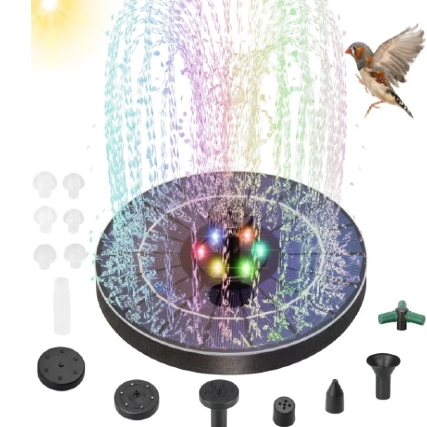
For example, Shenzhen BSV Solar Energy Co., Ltd. offers a compact Garden Mini Solar Water Fountain designed for birdbaths and small decorative ponds. This model uses environmentally friendly solar power and starts automatically in sunlight, eliminating the need for external electricity. It includes a 1500 mAh rechargeable battery and six colorful LED lights, allowing the fountain to operate and illuminate the garden for about three to four hours at night. The fountain also includes 11 interchangeable nozzles, producing spray heights between 50 and 70 cm, which helps attract birds and hummingbirds while adding movement to the garden landscape.
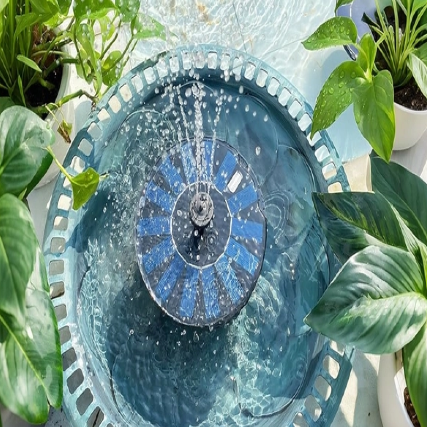
Submersible solar pumps are installed underwater while the solar panel remains outside the pond, which allows the fountain to maintain a clean visual appearance because the pump system is hidden beneath the water surface. This design is often used in decorative ponds where aesthetic simplicity is important.
An example is the 1.4W Outdoor Solar Fountain produced by Shenzhen BSV Solar Energy Co., Ltd., which features an upgraded glass solar panel that powers the fountain directly using sunlight without requiring a battery. In strong sunlight conditions, the fountain can produce a spray height of approximately 17.7 inches, and it includes seven interchangeable nozzle designs that allow users to create different water spray effects depending on their personal preferences.
Large landscape ponds often require stronger water circulation to maintain oxygen levels and prevent algae growth, which makes solar aeration fountains an ideal choice for larger water features. These fountains use powerful pumps and higher wattage solar panels to generate strong water jets that improve oxygen exchange throughout the pond.
For larger ponds and decorative gardens, Shenzhen BSV Solar Energy Co., Ltd. also offers a 10W Garden Flower Spraying Kit Fountain, which combines high-efficiency solar panels and a durable waterproof pump system. Constructed from premium ABS materials, this fountain produces multiple spray patterns such as cascading streams, bubbling flows, and fine mist effects while operating quietly with low energy consumption. The system can automatically activate at sunrise and stop at sunset, making it a convenient and eco-friendly option for modern outdoor landscapes.
Higher wattage solar fountain kits are recommended for larger ponds that require stronger water circulation.
Choosing the right Solar Fountain for a garden pond requires careful consideration of pond size, solar panel power, pump capacity, spray height, and sunlight exposure. When these factors are matched correctly, the fountain becomes both a beautiful decorative feature and a practical tool for improving water circulation and oxygen levels.
Reliable manufacturers such as Shenzhen BSV Solar Energy Co., Ltd. provide a variety of solar fountain solutions ranging from compact floating fountains for birdbaths to powerful solar fountain kits designed for larger ponds. With proper installation, sufficient sunlight exposure, and regular maintenance, a well-selected solar fountain can transform an ordinary garden pond into a vibrant and eco-friendly water feature that enhances both the landscape and the surrounding ecosystem.
A: A Solar Fountain uses sunlight to power a pump that circulates pond water without external electricity.
A: Choose a Solar Fountain based on pond size, solar panel power, pump flow rate, and sunlight availability.
A: A Solar Fountain improves water circulation, adds visual movement, and helps maintain healthier pond conditions.
A: A Solar Fountain may stop working due to weak sunlight, clogged pumps, low water levels, or debris blocking the filter.